Balance is one of those things you never think about until it starts going wrong.
A stumble on a trail. A split-second wobble stepping off a curb. A run that feels shakier than it should. These are not random. They are signals from systems that have been quietly under-used.
Walking fixes this, and returning adults are the ones who benefit most.
Not because walking is remedial. Because anyone who has been inactive for a while has lost some of the neuromuscular sharpness that keeps them stable, and walking is one of the most efficient ways to get it back.
Why balance fades during a layoff
Coordination is not a fixed trait. It is a skill maintained by practice.
When you stop moving regularly, your nervous system gets fewer inputs about where your body is in space. The proprioceptive signals from your feet, ankles, and hips, the ones that tell your brain where the ground is and how to react, become less frequent and less precise.
The hardware does not disappear. It just gets less sharp.
That matters for anyone coming back to running. The aerobic engine rebuilds relatively quickly. The neuromuscular layer, which governs stability and coordination, takes longer. That gap is where tweaked ankles and stumbles live.
This is general information, not medical advice. If you are returning after a gap or managing a health condition, check with your doctor before starting.
What walking actually trains
Every step of a walk recruits a small balance calculation. Your body shifts weight, adjusts for slight changes in surface, and steadies your trunk, all without you noticing.
Do this for thirty minutes on varied ground and you have run a lot of those calculations.
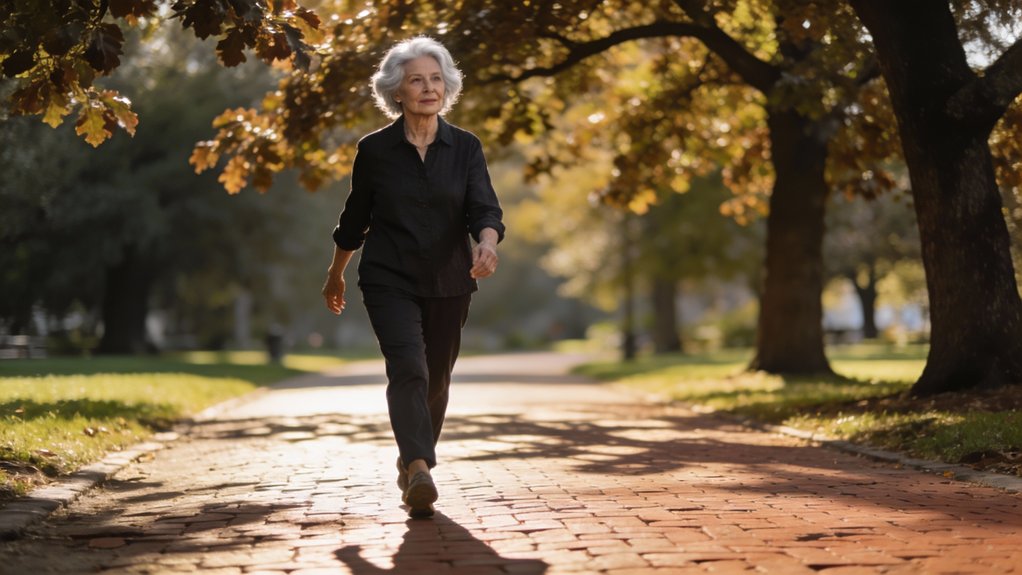
The terrain does the coaching. Grass, gravel, and slightly uneven paths challenge your foot and ankle differently than a flat treadmill belt. Your nervous system has to respond to real variation, not a predictable loop.
This proprioceptive load is why a regular walking habit builds stability that shows up later in your running: fewer wobbles, better foot placement, and a stride that holds up longer before form falls apart.
Simple balance moves that pair with a walk day
Walking builds the base. A few deliberate moves sharpen it.
None of these require a gym. Most take under ten minutes. Add them at the end of a walk or on a rest day:
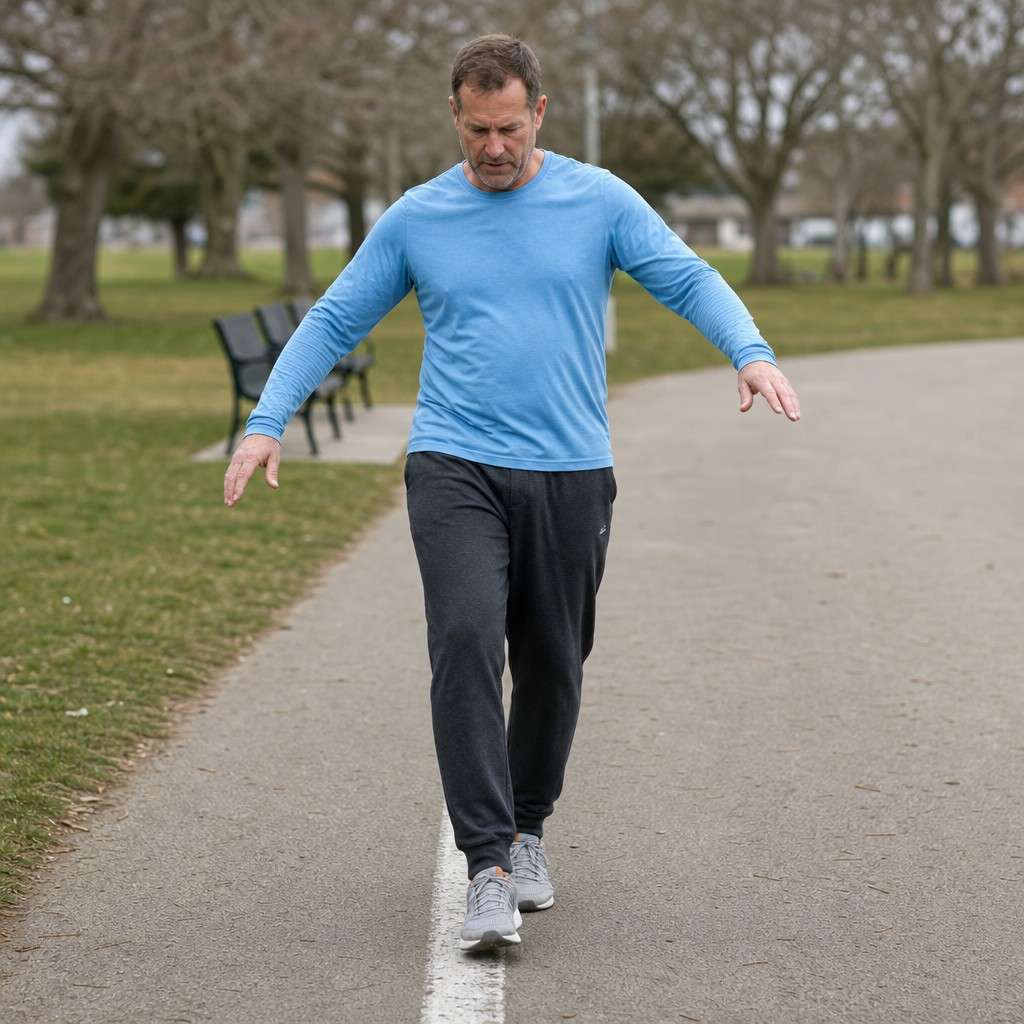
- Heel-to-toe walking: walk a short stretch placing each heel directly in front of the opposite toe. Ten to fifteen paces. It challenges the coordination that keeps you upright on narrow paths and during quick direction changes.
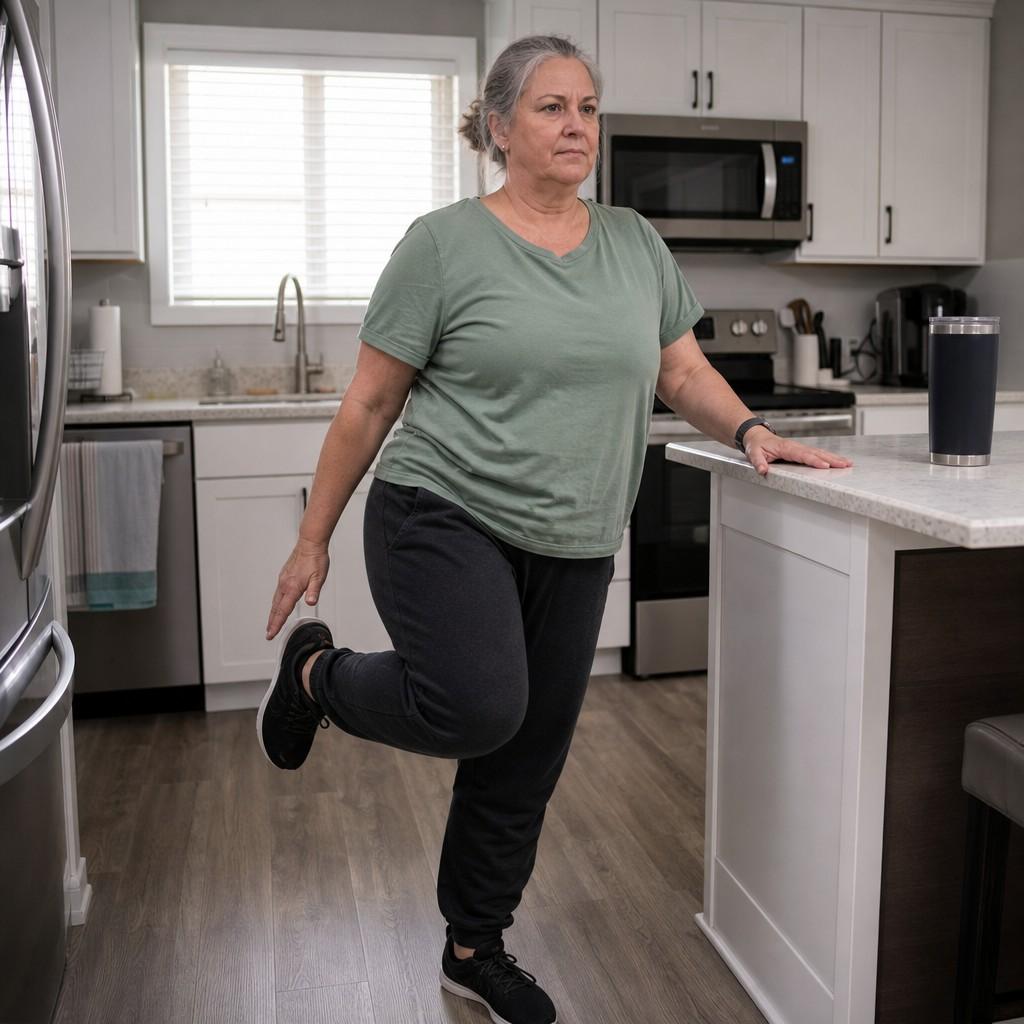
- Single-leg stands: stand on one foot for ten to twenty seconds. Do it near a wall at first. Progress to doing it with eyes closed once it feels easy. This trains the ankle stabilizers that running recruits constantly.
- Lateral side steps: step to the side for fifteen to twenty steps, then back. Simple hip and glute work that walking alone does not cover.
- Backward walking: twenty to thirty steps in reverse. Different muscle groups activate and your brain has to work harder to track spatial position.
Balance training does not have to look like balance training. A varied walk route does most of the work without a single dedicated drill.
These are not complex. That is the point. Consistency with simple moves builds the neuromuscular foundation that protects your joints and makes your running more efficient over time.
The payoff for returning runners
Better balance shows up in running before you expect it.
Foot placement becomes more automatic. Less conscious correction on uneven ground means less energy wasted and a lower ankle-roll risk, the injury that sidelines returners more often than any glamorous overuse story.
Coordination between your hips, knees, and feet improves. Your body learns to absorb each stride more evenly, which takes pressure off the joints that tend to complain first.
Per the CDC’s physical activity guidelines, building activity gradually, mixing modes and intensities, is the approach that produces sustainable fitness gains without the breakdown. Walking and balance work fit that model exactly. They are not training-wheel activities to graduate out of. They are ongoing maintenance that the cardio-only approach misses.
The strength work that protects returning runners’ joints covers similar ground from a different angle, targeting the muscle groups around your knees, hips, and Achilles that need support as your mileage builds. Balance training and strength training reinforce each other.
How to fold this into a comeback week
The simplest version: one or two dedicated walk days, with a few balance moves added at the end.
Those walk days are not easy days. They are training. They are building something your running days cannot build alone.
The returner who skips cross-training gets fitter faster and breaks down sooner. The one who mixes modes builds slower and runs longer.
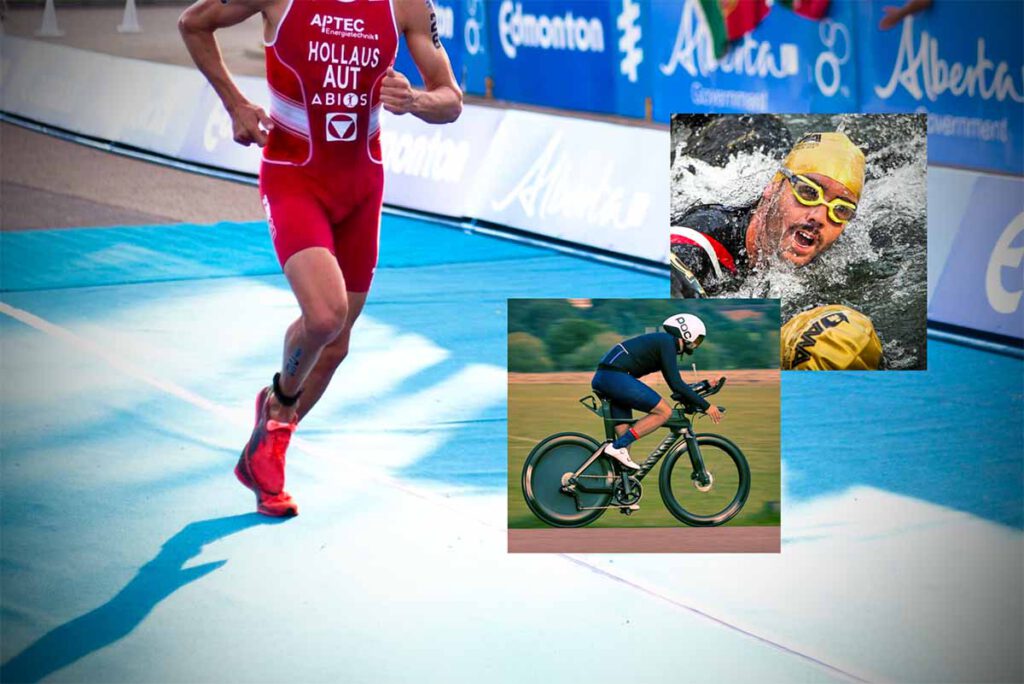
If you are at a point where the comeback is mostly walk-run and you are wondering what happens next, the overview of multisport distances is a low-pressure look at where adding variety can eventually lead, if curiosity ever tips that way. No obligation to race anything. Knowing the landscape helps you see that mixing modes is not a detour from fitness, it is the destination.
For now, a walk that ends with ten minutes of balance work is a good training day. Do that consistently and your running will feel it.